
The short answer
For most travellers the simplest and often cheapest option is to take your European gas bottles out before shipping and buy a local bottle when you arrive. A North American bottle is certified for refilling there and already has the right connection, so you can refill or swap it anywhere. You only need one adapter to connect it to your vehicle’s gas system, and you buy that in Europe before you leave.
If you have a fixed gas tank or a refillable tank, you can keep it, but it must be completely empty for shipping, with a gas-free certificate, and you will need the right filling adapter on the road.
Why European bottles are hard to refill in North America
- USA: fillers follow the propane code NFPA 58, adopted by the states. Since April 2002 it requires the common 4 to 40 lb portable cylinders to have an overfill prevention device (OPD) before they can be refilled, marked “OPD” on the valve with a triangular hand wheel. European bottles do not have one and are not DOT-marked, so many filling stations will refuse them.
- Canada is stricter. Portable propane cylinders are regulated by Transport Canada and carry a TC stamp. They can only be refilled at an approved facility, by a trained attendant, and must be requalified every 10 years. A European bottle has no TC marking, so expect it to be refused.
- Campingaz bottles (for example the 907) cannot be refilled or exchanged in North America, and there is no bottle of the same size there.
- Never refill small disposable 1 lb camping cylinders. It is illegal in Canada and unsafe everywhere.
Option 1 (usually best): buy a local bottle on arrival
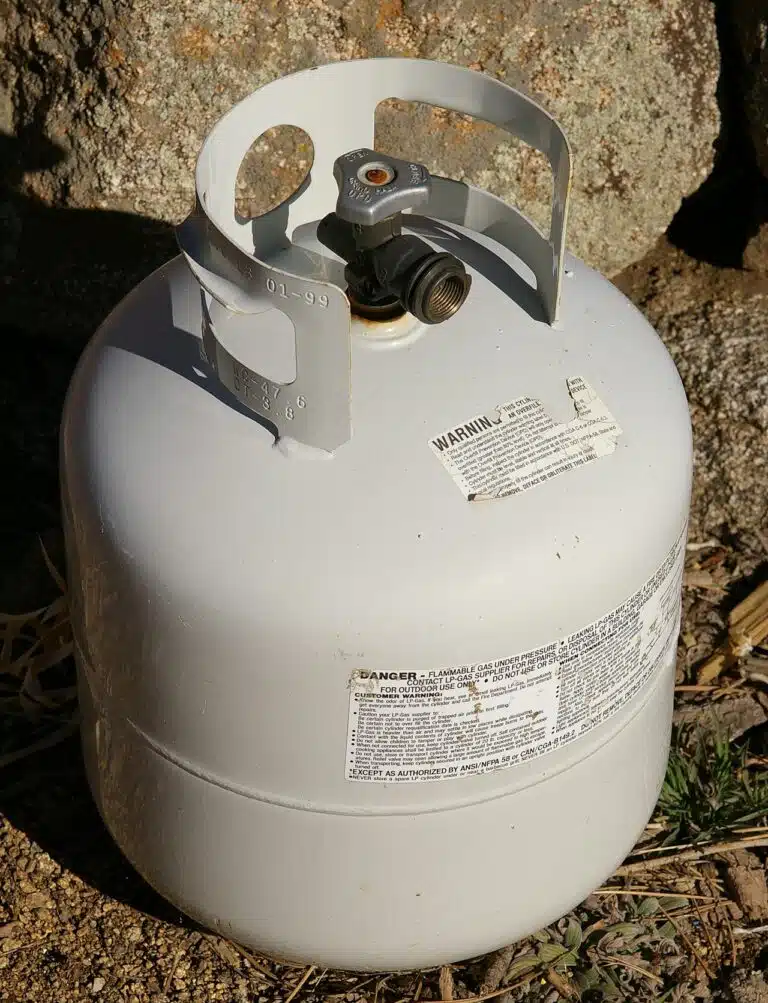
- The most common size is the 20 lb (about 9 kg) bottle sold for barbecues. Smaller 5 lb (about 2.3 kg) refillable bottles also exist.
- You can buy them at hardware stores, camping shops and many supermarkets or fuel stations. Most also run bottle exchange: swap an empty for a full one of the same size.
- New North American bottles come with an OPD valve and the standard connection, so refilling is straightforward.
- Check before you go:
- Will a 20 lb or 5 lb bottle fit in your gas locker?
- Which adapter connects it to your regulator? North American bottles use a “POL” or “QCC1 / Type 1” connection. Specialist gas shops in Europe sell adapters from these to German, UK or French systems. Buy it before you travel: they are often out of stock.
- Does the bottle still fit with the adapter fitted?
- Often cheaper than keeping your own bottles: no gas-free certificate, no refill refusals, and you can sell or give the bottle away at the end of your trip.
Option 2: a fixed tank or refillable tank


- Many European motorhomes have a fixed LPG tank or a refillable tank (for example Gaslow or Alugas type) with an external filling point.
- The filling nozzle used in the USA, Chile and Argentina is the ACME type, the same as in Germany, Belgium and Ireland. If your filling point is a UK bayonet, a French or Italian “dish” or another type, carry an ACME adapter.
- Mexico: propane plants (“gaseras”) fill vehicle tanks by the litre. Some need an adapter for European fittings, so carry yours.
- Chile: LPG (“GLP”) stations and gas plants regularly fill European tanks and bottles with an adapter.
- Argentina: gas plants and some tanker depots fill LPG with an ACME connection; adapter shops can fit one to your bottle. Do not confuse GNC (compressed natural gas for cars) with GLP (LPG): GNC is not for cooking or heating.
- Fill to the correct level only. Overfilling is dangerous, and in Canada and the USA attendants fill by weight or volume.
Uruguay (arriving in Montevideo)
Short answer: take your European bottles out before shipping and buy a local 13 kg supergás bottle in Montevideo. It is cheap, it is easy to swap for a full one anywhere, and it comes with the local fitting. Take your bottles out before shipping. Any bottle or fixed tank that stays in the vehicle must be empty with a gas-free certificate.
What gas is used. Uruguayans call bottled LPG (GLP) “supergás”. It comes from Ancap’s La Teja refinery, with some imported. It is a propane/butane mix.
Bottle sizes. All four distributors (Acodike Supergas, Riogas, Megal and DUCSA/Ancap) sell the 13 kg garrafa and the 45 kg cylinder. Megal also sells a 3 kg microgarrafa. Households swap an empty garrafa for a full one at a shop or by delivery.
Price. Ancap’s official price for a full 13 kg garrafa was UYU 1,216 in October 2026, about UYU 94 per kg. Your first garrafa costs more because you also pay for the cylinder itself.
Refilling European bottles and fixed tanks. Travellers report that some filling plants in and near Montevideo, including Acodike and Riogas sites, will fill foreign bottles and fixed tanks. Bring an ACME adapter. Some sites have no meter, so know your tank’s capacity. Hours are short and some close on Saturdays. These are traveller reports, not company policy, so call ahead.
Connecting a local bottle. A Uruguayan garrafa will not fit a European regulator. A local gas fitter can supply a regulator and hose.
Brazil
Short answer: do not plan on refilling European bottles in Brazil. The law only allows gas to be sold in branded, sealed cylinders filled by an authorised distributor. If you are driving on from Uruguay, fill up before the border or switch to a Brazilian bottle.
What gas is used. Brazilians call it GLP or “gás de cozinha”. It is a propane/butane mix. The standard household bottle is the 13 kg P13 botijão. Smaller and larger sizes exist.
Price. The regulator ANP reported an average of R$ 114.66 for a full P13 in July 2026. Prices reach R$ 160 or more in some areas. The first bottle costs more because you also buy the cylinder. One traveller reported about R$ 360 for a 13 kg bottle and about R$ 330 for an 8 kg bottle, including gas.
Refilling foreign bottles. Lei 15.348/2026 requires gas to be sold only in sealed cylinders carrying an authorised distributor’s brand. ANP is reviewing whether to let any authorised filler fill any cylinder. Travellers report that a few small sellers will fill foreign bottles, while others refuse and say it is illegal. Treat any refill as a lucky find.
Vehicle use. Brazil bans LPG as an engine fuel (CONTRAN Resolution 916/2022), and there are no autogas stations. A fixed tank cannot be topped up at a fuel station.
Border towns. Brazilian and Uruguayan bottles have different valves, so they do not share a regulator.
Uruguay and Brazil: your questions answered
Can I refill my European gas bottle in Montevideo? Often, yes. Travellers report that some Montevideo filling plants will do it if you bring an ACME adapter. A local 13 kg garrafa is usually simpler.
Can I refill a European gas bottle in Brazil? Not reliably. Brazilian law only allows gas to be sold in branded cylinders filled by authorised distributors, so most sellers will refuse. Fill up in Uruguay or buy a Brazilian P13 botijão.
How much does a gas bottle cost in Uruguay and Brazil? A full 13 kg garrafa in Uruguay was about UYU 1,216 in October 2026. A full P13 in Brazil averaged about R$ 115 in mid-2026. You pay extra for the cylinder on your first purchase.
Can my motorhome arrive in Montevideo with gas on board? Only gas-free. Take removable bottles out. Any bottle or fixed tank that stays in the vehicle must be empty with a gas-free certificate.
Shipping rules: what the carrier needs
- Take removable gas bottles out before you deliver the vehicle. Any bottle that stays in the vehicle must be empty with a gas-free certificate. Some North American export sailings accept an empty tank with no pressure instead of a certificate; your booking confirmation gives the rule for your route and carrier.
- Fixed tanks must be completely empty, with a gas-free certificate from a licensed company, no more than 5 working days old, and left in the vehicle.
- The carrier’s guidelines are linked in your quote and booking confirmation. Please read them before you deliver.
- Because a gas-free certificate has a cost and a time limit, many travellers find it simpler to remove the bottles and buy local ones on arrival.
Your questions answered
Can I refill my European gas bottle in the USA or Canada? Sometimes in the USA, rarely in Canada. Fillers there need certified cylinders with an overfill prevention device (USA) or a Transport Canada stamp (Canada). European bottles have neither, so most travellers buy a local bottle instead.
What size gas bottle should I buy in North America? The 20 lb (about 9 kg) bottle is the most common and easiest to exchange. A 5 lb (about 2.3 kg) bottle suits small gas lockers. Measure your locker before you go.
What adapter do I need for a North American gas bottle? One that connects the bottle’s POL or QCC1 (Type 1) valve to your vehicle’s regulator. Buy it from a specialist gas shop in Europe before you travel.
Can I ship my motorhome with gas bottles inside? Only if they are gas-free. Take removable bottles out before delivery. Any bottle or fixed tank that stays in the vehicle must be empty with a gas-free certificate no more than 5 working days old.
Is a gas-free certificate worth it? For a fixed tank you need one to ship. For removable bottles it is often cheaper and simpler to leave them at home and buy a local bottle on arrival.
Can I refill my tank in Mexico and South America? Yes. Gas plants in Mexico, and LPG stations and plants in Chile and Argentina, fill vehicle tanks and bottles. Carry a set of filling adapters, including an ACME adapter.
Shipping to the Americas? Get Instant pricing or read more about overland vehicle shipping.